
DC04-Good Governance
{{org_field_logo}}
{{org_field_name}}
Registration Number: {{org_field_registration_no}}
Good Governance: Organisational Structure Policy
1. Purpose and Scope
This policy outlines the governance framework of {{org_field_name}} to ensure that we operate a well-led, safe, and high-quality domiciliary care service in compliance with the Care Quality Commission (CQC) Regulation 17 – Good Governance. The policy provides clarity on how we manage and govern our organisation to meet legal, regulatory, and ethical requirements.
2. Governance Framework
Governance is the system of rules, practices, and processes that {{org_field_name}} uses to manage its operations effectively. It provides a structured approach to decision-making, risk management, compliance, and quality assurance.
A strong governance framework ensures that our domiciliary care service is well-led, safe, and continuously improving in accordance with CQC Regulation 17 – Good Governance. It also ensures that we comply with legal, ethical, and regulatory obligations, including those set by the Health and Social Care Act 2008 (Regulated Activities) Regulations 2014.
Our governance framework is built on three key pillars:
2.1 Strategic Leadership
Strategic leadership ensures that {{org_field_name}} operates with a clear mission, vision, and values that align with best practice standards and CQC requirements. Leadership responsibilities include:
- Setting clear objectives for service delivery and organisational development.
- Developing and reviewing policies to maintain compliance with health and social care regulations.
- Ensuring financial sustainability through effective budgeting and resource allocation.
- Monitoring industry changes and regulatory updates to ensure the organisation remains compliant.
- Providing leadership and support to staff to foster a culture of quality care and continuous improvement.
Our leadership team includes:
- The Registered Provider, responsible for ensuring that the service meets all legal and regulatory requirements.
- The Nominated Individual, responsible for overseeing the management of regulated activities and acting as a key point of contact for CQC.
- The Registered Manager, responsible for the daily operational management of the service.
2.2 Oversight and Monitoring of Service Quality, Safety, and Compliance
Governance ensures that {{org_field_name}} has robust monitoring systems in place to oversee the quality, safety, and compliance of the services we provide. This includes:
- Quality assurance systems to evaluate the standard of care delivered.
- Regular audits and inspections covering:
- Care quality and safety audits to ensure compliance with Regulation 12 – Safe Care and Treatment.
- Health and safety checks to assess risks and prevent accidents.
- Staff training audits to ensure ongoing competency and professional development.
- Complaints and incident reporting in line with Regulation 16 – Receiving and Acting on Complaints.
- Performance monitoring to assess staff efficiency, response times, and overall service user satisfaction.
- Incident reporting and learning frameworks to address errors, safeguarding issues, and regulatory breaches.
- Regular CQC compliance reviews, ensuring adherence to statutory obligations and best practice guidelines.
Through data-driven decision-making, {{org_field_name}} identifies areas for improvement, implements corrective actions, and continuously enhances service quality.
2.3 Engagement with Stakeholders
Governance is also about building strong relationships with stakeholders who are directly or indirectly impacted by our services. These include:
2.3.1 Service Users and Families
- Feedback mechanisms such as surveys, complaints systems, and regular service reviews.
- Person-centred care planning, ensuring users have a say in how their care is delivered.
- Complaints and concerns handling, ensuring a transparent and responsive approach to service improvement.
2.3.2 Staff and Workforce
- Employee training and development, ensuring compliance with Regulation 19 – Fit and Proper Persons Employed.
- Whistleblowing policies, allowing staff to report concerns confidentially.
- Performance reviews and supervisions to support professional growth.
2.3.3 Regulatory and External Bodies
- Compliance with CQC and local authority requirements.
- Collaboration with NHS partners and safeguarding boards.
- Adherence to GDPR and data protection laws when handling sensitive information.
Through effective governance, {{org_field_name}} fosters transparency, accountability, and continuous improvement, ensuring a well-led, high-quality domiciliary care service that prioritises the safety and dignity of service users.
3. Organisational Structure
Our organisational structure provides a clear framework for decision-making, accountability, and effective governance within {{org_field_name}}. It ensures that responsibilities are well-defined and that care services are delivered efficiently, safely, and in compliance with CQC regulations.
By establishing a structured hierarchy, we maintain high standards of leadership, operational efficiency, and care quality, ensuring that every role contributes to the organisation’s success.
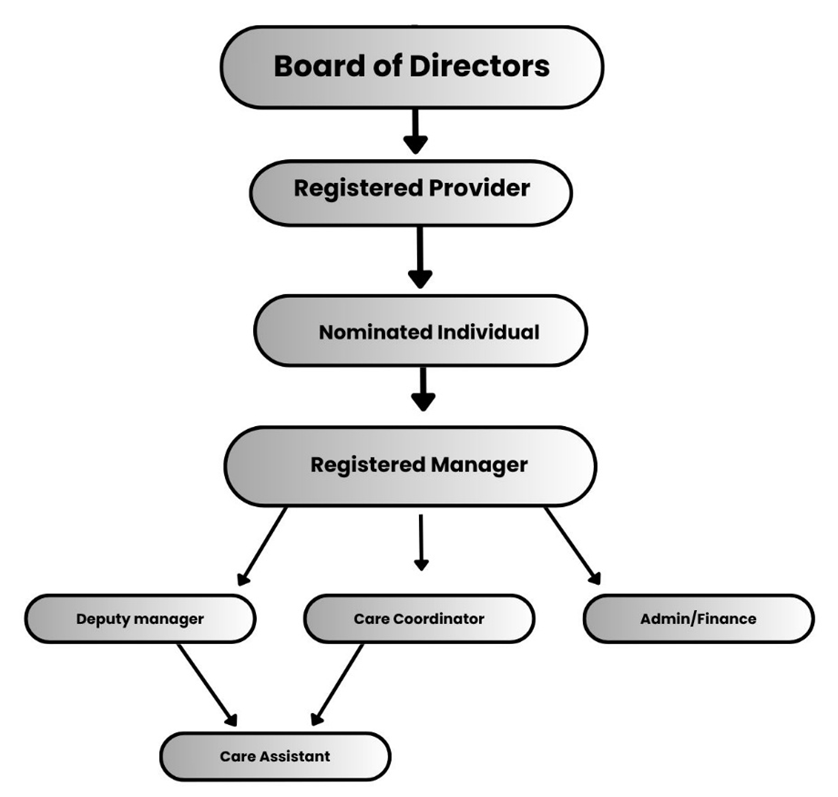
3.1 Organisational Structure Chart
Below is a structure chart illustrating the reporting lines and key roles within {{org_field_name}}:
3.2 Board of Directors
- The Board of Directors is responsible for the overall strategic direction, corporate governance, and financial oversight of the company.
- Directors ensure that the organisation meets all statutory obligations and adheres to CQC, Health and Social Care Act, and Care Act 2014 requirements.
- They provide support and scrutiny to the Registered Provider and senior management team.
3.3 Registered Provider
Name: {{org_field_name}}
The Registered Provider is the legal entity responsible for the overall management, regulation, and compliance of the domiciliary care service. This role includes:
- Ensuring that the service meets all legal, regulatory, and ethical requirements.
- Overseeing financial, strategic, and operational governance.
- Maintaining compliance with CQC regulations, Health and Social Care Act 2008, and Care Act 2014.
- Ensuring that effective policies, procedures, and governance structures are in place.
- Responding to CQC inspections, audits, and compliance assessments.
3.4 Nominated Individual
Name: {{org_field_nominated_individual_first_name}} {{org_field_nominated_individual_last_name}}
The Nominated Individual is appointed to act on behalf of the Registered Provider and is accountable for supervising the management of regulated activities. Their responsibilities include:
- Acting as the main point of contact between the provider and CQC.
- Ensuring that the service is well-led and adheres to the CQC fundamental standards.
- Supervising the Registered Manager and other senior leadership roles.
- Ensuring timely action plans for any areas requiring improvement.
3.5 Registered Manager
Name: {{org_field_registered_manager_first_name}} {{org_field_registered_manager_last_name}}
The Registered Manager is responsible for the day-to-day running of the service, ensuring that high-quality care is provided in a safe and effective manner. This role is crucial for:
- Managing care operations, staff, and compliance with all legal requirements.
- Overseeing staff recruitment, training, and performance management.
- Ensuring safe care and treatment in compliance with Regulation 12.
- Implementing and reviewing care policies, risk assessments, and audits.
- Handling complaints, safeguarding issues, and regulatory reporting.
3.6 Deputy Manager
Supports the Registered Manager in operational leadership.
- care delivery
- acts as Manager in their absence
- oversees rotas
- supervisions
- staff performance
3.7 Care Coordinators
Care Coordinators play a key role in organising and managing service delivery. They:
- Oversee the scheduling and allocation of care workers.
- Maintain communication with service users, families, and staff.
- Ensure that care plans are up-to-date and tailored to individual needs.
- Monitor and address any operational challenges such as staff shortages or care quality concerns.
- Assist in incident reporting, safeguarding, and regulatory compliance.
3.8 Care Workers
Care Workers are the frontline staff delivering direct care and support to service users in their own homes. They:
- Provide personal care, medication assistance, meal preparation, and companionship.
- Work in line with individualised care plans to ensure person-centred support.
- Adhere to safeguarding policies to protect service users from harm.
- Report any concerns, incidents, or service user changes to senior staff.
- Complete mandatory training and ongoing professional development.
3.9 Admin/Finance
Finance & Administration Team: Handles payroll, budgeting, and financial oversight.
IT & Data Protection Officer: Ensures secure record-keeping and compliance with GDPR regulations.
4. Governance Responsibilities
Our governance responsibilities ensure that {{org_field_name}} operates in a well-led, safe, and compliant manner, meeting all regulatory and legal obligations. This section outlines how governance is embedded into our organisation through leadership, monitoring, quality assurance, and compliance.
4.1 Managing and Governing the Organisation
We maintain robust governance by implementing structured leadership, oversight mechanisms, and accountability frameworks that support our strategic direction and operational efficiency.
Key governance practices include:
Regular Management Meetings
- Monthly governance and performance meetings to evaluate key performance indicators (KPIs), staffing, financial sustainability, and service user outcomes.
- Quarterly strategy reviews to address operational challenges and implement improvements.
- Annual business planning sessions to set objectives and align with CQC and legal requirements.
Compliance with CQC Regulations
- Adherence to Regulation 17 – Good Governance, ensuring systems are in place to monitor and improve service quality.
- Annual CQC audits and self-assessments to verify compliance with fundamental care standards.
- Implementation of Corrective Action Plans (CAPs) following any CQC feedback or inspections.
Policy and Procedure Management
- Policies aligned with Health and Social Care Act 2008 (Regulated Activities) Regulations 2014 to ensure best practices.
- Regular policy reviews and updates based on emerging risks, regulatory updates, and sector best practices.
- Staff training on policy adherence, ensuring awareness and compliance across the organisation.
4.2 Continuous Assessment and Improvement
At {{org_field_name}}, we have a comprehensive approach to assessing and monitoring the quality of our service. We use a range of quality assurance systems and processes—including regular audits, performance reviews, feedback collection, and incident monitoring—to ensure that our care is safe, effective, and meets regulatory standards. These systems enable us to identify trends, measure outcomes, and benchmark our performance against national standards.
Internal Audits
- Quarterly audits covering care quality, staff training, safeguarding, medication management, and infection control.
- Spot-checks and unannounced visits to service users’ homes to assess care delivery.
- Audit reports reviewed by senior management, ensuring recommendations are actioned.
Action Plans for Improvement
- Corrective and preventive action plans (CAPAs) implemented for any identified non-compliance.
- Staff performance reviews and competency checks to ensure adherence to care standards.
- Benchmarking against national standards, using sector data to measure service effectiveness.
Staff Training and Development
- Mandatory and ongoing professional development training for all staff.
- Supervision and appraisals every six months to monitor performance and identify training needs.
- Workforce planning and skills gap assessments to enhance care delivery.
Quality Improvement
Continuous improvement is central to our governance framework. We regularly review audit outcomes, feedback, and performance data to identify areas for development. Where improvements are required, we implement targeted action plans, allocate resources to support change, and set measurable goals for improvement. Progress is tracked through regular management meetings and audits, and successful improvements are embedded into policy and practice. We also promote a culture of learning, encouraging staff to contribute ideas and take part in quality improvement initiatives.
Internal Audits & Review Schedule
| Audit Area | Frequency | Responsible Person | Purpose |
| Care Quality & Safety | Quarterly | Registered Manager | Ensure person-centred care, safety, and compliance |
| Staff Training & Competency | Quarterly | Deputy Manager / RM | Confirm all staff meet skill and training requirements |
| Medication Management | Quarterly | Registered Manager | Monitor safe administration and storage of medication |
| Infection Prevention & Control | Quarterly | Deputy Manager | Ensure hygiene and PPE standards are met |
| Health & Safety | Quarterly | Admin / Health & Safety Lead | Reduce workplace risks and ensure compliance |
| GDPR / Data Protection | Quarterly | Data Protection Officer | Check data security, accuracy, and legal compliance |
| Complaints & Incidents | Monthly Review | Registered Manager | Identify trends, resolve issues, and improve service quality |
| CQC Compliance Self-Assessment | Annually | Nominated Individual | Prepare for inspection, ensure ongoing compliance with regulations |
4.3 Seeking and Acting on Feedback
We foster a culture of openness and continuous improvement by actively engaging with service users, families, staff, and external stakeholders.
Service User Engagement
- Annual and quarterly service user satisfaction surveys to collect direct feedback.
- Regular care plan reviews with service users and their families to ensure needs are met.
- Feedback reports analysed and acted upon to improve service quality.
Staff Consultations and Engagement
- Monthly staff forums and team meetings to discuss service performance, policy updates, and challenges.
- Whistleblowing policies to protect staff who report concerns.
- Open-door management policy to encourage staff participation in decision-making.
Complaints Handling
- Clear, accessible complaints procedure, in line with Regulation 16 – Receiving and Acting on Complaints.
- Independent investigation of complaints, ensuring transparency and accountability.
- Trends analysis of complaints to identify systemic issues and implement corrective actions.
4.4 Assessing, Monitoring, and Improving Quality & Safety
Ensuring high standards of care, safety, and compliance is at the core of our governance framework.
Risk Management and Health & Safety
- Regular risk assessments to identify and mitigate potential hazards in service users’ homes and staff work environments.
- Proactive risk mitigation plans implemented to reduce incidents, accidents, and safeguarding concerns.
- Lone worker safety policies and emergency response procedures to protect care staff.
Incident Reporting and Learning Culture
- Mandatory incident reporting system, covering medication errors, falls, safeguarding concerns, and complaints.
- Root Cause Analysis (RCA) for significant incidents, ensuring lessons are learned and recurrence is prevented.
- Quarterly incident review meetings to share findings and improve practice.
Safeguarding Compliance
- Strict adherence to safeguarding policies, ensuring compliance with Regulation 13 – Safeguarding Service Users from Abuse and Improper Treatment.
- Designated Safeguarding Lead (DSL) responsible for ensuring prompt action on safeguarding concerns.
- Staff safeguarding training refreshed annually, ensuring competency in recognising and responding to abuse.
4.5 Record Keeping and Data Protection
We ensure accurate, secure, and confidential management of service user records, staff files, and operational data.
Accurate and Secure Record-Keeping
- Service user records include detailed care plans, risk assessments, medical history, and consent forms.
- Staff records include background checks, employment contracts, training logs, and performance reviews.
- Digital record-keeping system with encrypted access, ensuring data integrity.
GDPR and Data Protection Compliance
{{org_field_name}} is committed to full compliance with both the General Data Protection Regulation (GDPR) and the Data Protection Act 2018. We ensure that all staff understand their responsibilities under these laws and that robust processes are in place to protect the privacy and confidentiality of all service user and staff data.
- Strict adherence to the General Data Protection Regulation (GDPR), ICO, and the Data Protection Act 2018, ensuring all personal data is handled lawfully, fairly, and transparently.
- Regular staff training on data protection laws and handling of sensitive information.
- Data security audits conducted quarterly to identify risks and ensure compliance.
Data Audits and Monitoring
- Regular spot checks to ensure accuracy, completeness, and compliance of records.
- Retention policies in place, ensuring records are kept in line with legal requirements.
- Access control measures, ensuring only authorised staff can view sensitive data.
4.6 Compliance with Statutory Requirements
We are committed to full compliance with all legal, ethical, and professional regulations governing domiciliary care services.
CQC Registration and Compliance
- Ongoing compliance with CQC regulations, ensuring adherence to fundamental care standards.
- Annual CQC self-assessments and improvement plans to maintain high-quality service provision.
Mental Capacity Act 2005 and Care Act 2014 Compliance
- Ensuring service users’ rights and decisions are respected, in line with the Mental Capacity Act 2005.
- Comprehensive staff training on mental capacity assessments and best interest decision-making.
- Adherence to the Care Act 2014, ensuring person-centred care and safeguarding responsibilities are met.
Duty of Candour (Regulation 20)
- Transparent communication with service users, families, and regulatory bodies regarding significant incidents.
- Open disclosure policies, ensuring timely and honest responses to adverse events.
Training on Duty of Candour, ensuring staff understand their responsibilities when something goes wrong.
Responsible Person: {{org_field_registered_manager_first_name}} {{org_field_registered_manager_last_name}}
Reviewed on: {{last_update_date}}
Next Review Date: {{next_review_date}}
Copyright © {{current_year}} – {{org_field_name}}. All rights reserved.